 Atanaria
Doriane Pin’s Mercedes W12 test should be read as much more than a promising private run at Silverstone. It is a sporting proof point, a symbolic breakthrough, and a political argument for why women still need real, structural access to Formula 1 seats — not just visibility, development roles, or well-meaning applause.
Doriane Pin and the W12
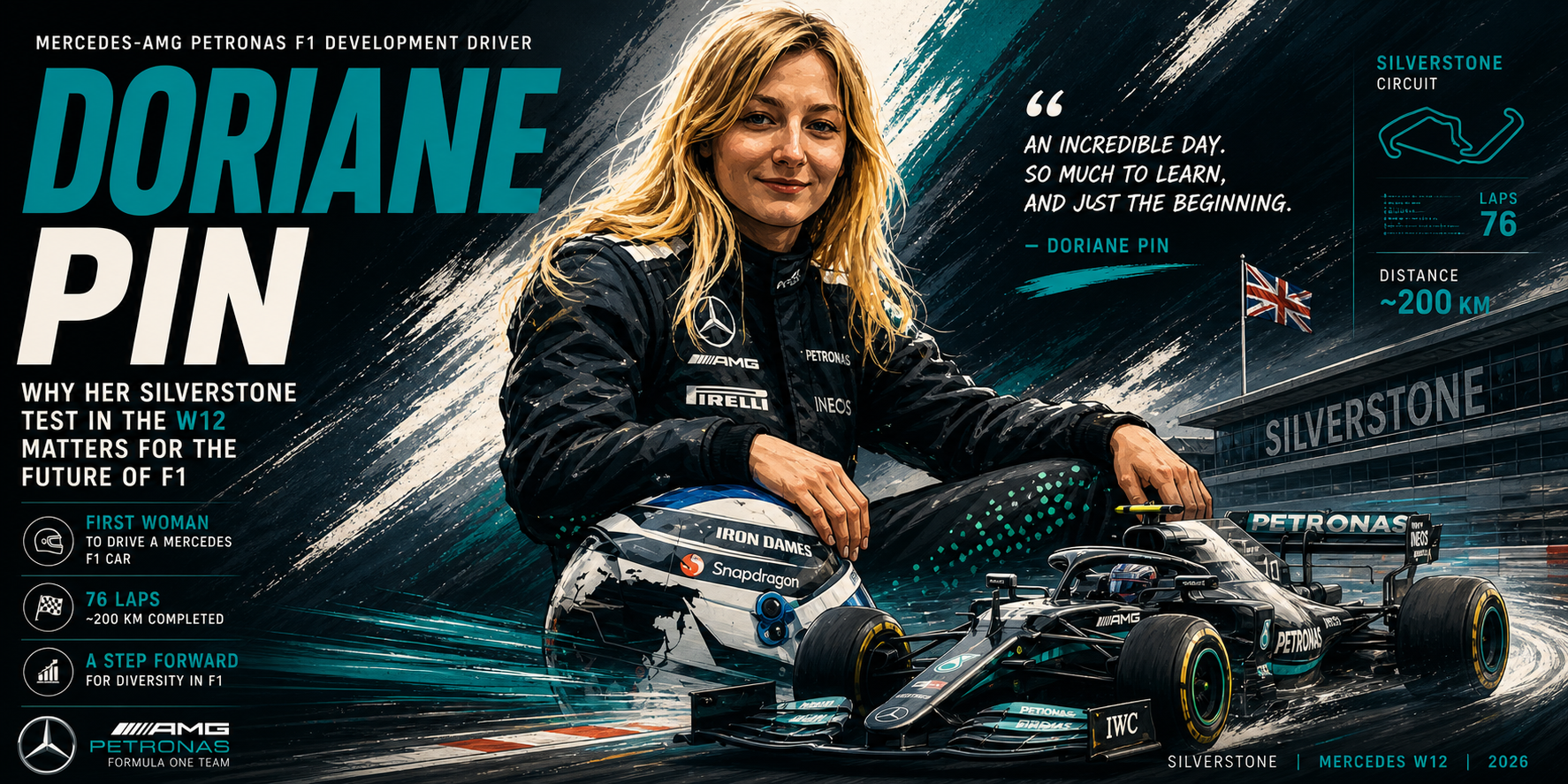
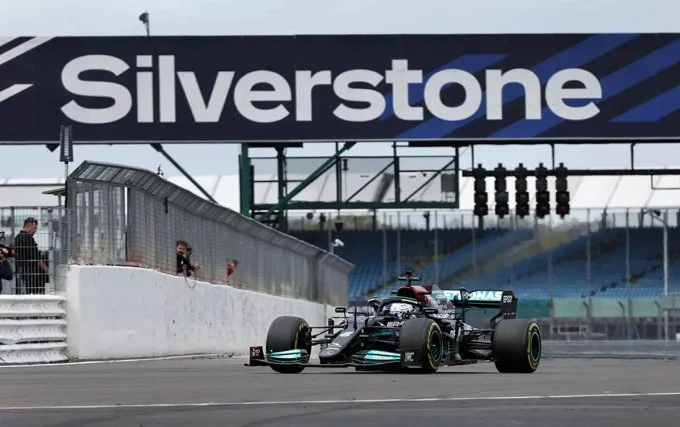
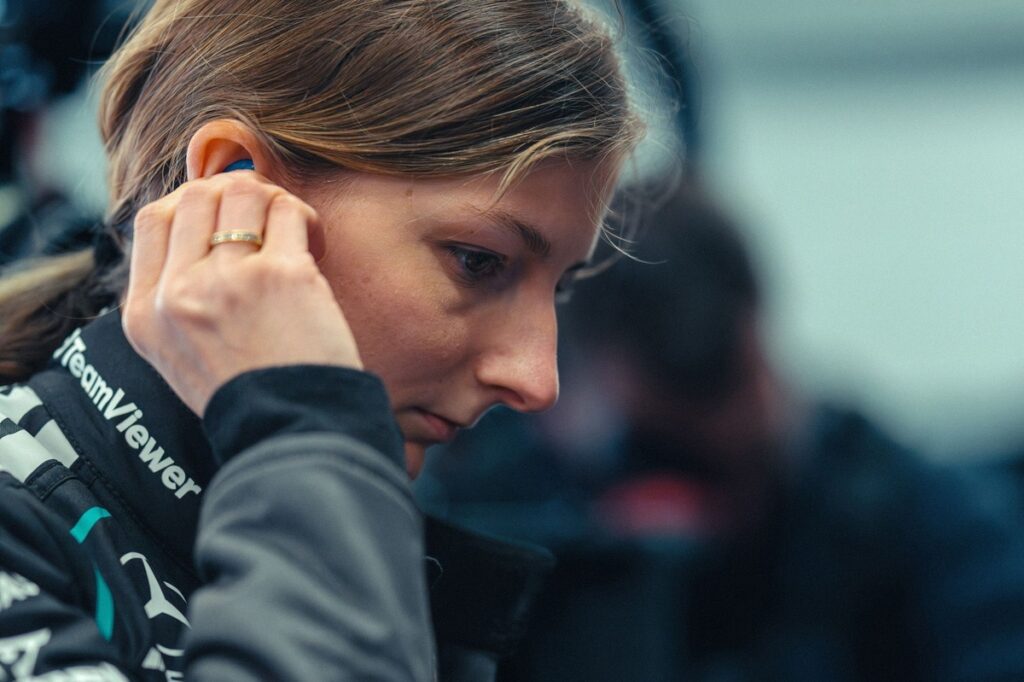
Mercedes gave Pin the wheel of its 2021 W12, a world-championship-winning car, and she completed 76 laps and 200 km at Silverstone as part of the team’s Testing of Previous Cars programme. That alone matters because it places her inside the most elite machinery in the sport, under the same technical expectations that shape any serious F1 assessment. Mercedes also said she impressed with her pace, feedback, and technical understanding, which is exactly what you want to hear about a driver whose future is supposed to rise through performance, not symbolism. We had already profiled Doriane and stated that she was the future of Formula 1… we might have been just right.
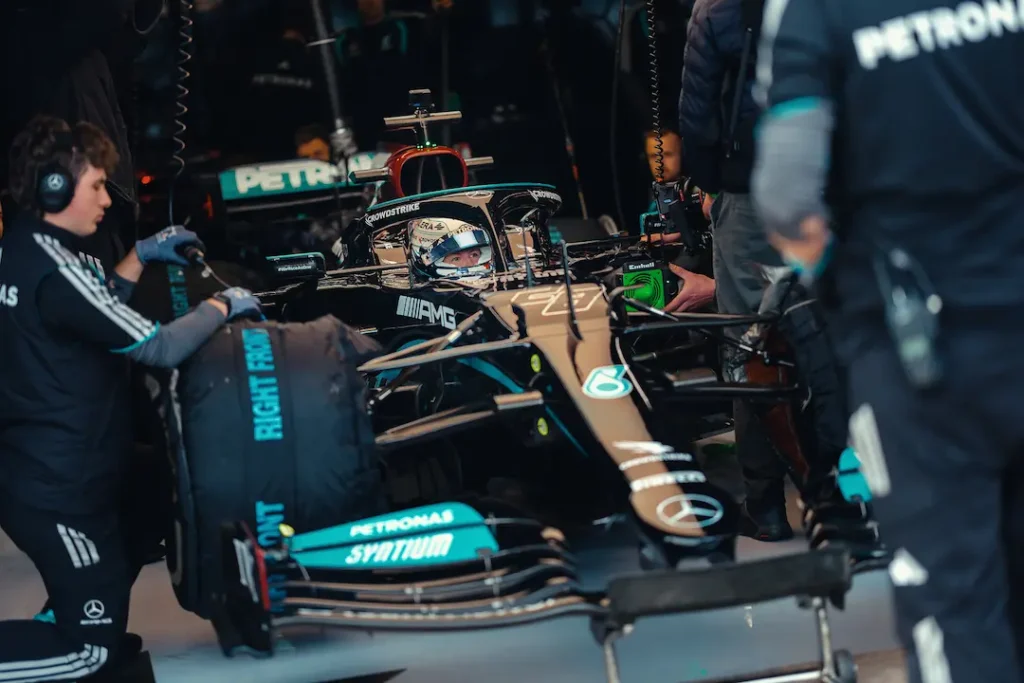
What makes the test especially relevant is the nature of the W12 itself. A modern Formula 1 car is not just fast; it is physically exacting, and the high downforce level means the car rewards commitment, precision, and trust in the chassis while punishing hesitation. Pin’s own preparation — simulator work, engineering briefings, and close integration with the team — shows that she approached the car as a professional performance problem, not as a ceremonial outing. In other words, she did not merely survive the car; she adapted to it.
That adaptation is crucial. High-downforce driving is about carrying speed through corners with minimum lift, holding the car in the aero window, and accepting the physical load that comes with lateral and longitudinal grip. For a driver stepping into a contemporary F1 machine, the challenge is not only raw bravery, but the ability to recalibrate braking points, steering inputs, and neck/upper-body resistance so the lap remains fluid rather than forced. Pin’s feedback after the test suggested exactly that kind of adjustment: a driver learning the language of the car quickly and accurately.
A milestone with meaning
The reason this test resonates beyond motorsport circles is that it breaks a pattern. Mercedes does not hand a modern F1 car to a woman every day, and Pin became the first woman to drive a Mercedes F1 car, as well as the first F1 Academy champion to complete a Formula 1 test. That sentence is important because it exposes how rare the pathway still is, even in a sport that publicly celebrates merit and competition. If one test feels historic, the question is not whether it should be celebrated, but why the history took so long to arrive.
Pin’s message after the test also cuts through the old excuses. Her performance supports the argument that there is no mystical “female limitation” that makes Formula 1 out of reach; what matters is preparation, access, and opportunity. That is why the moment should be treated as a challenge to the sport’s gatekeepers, not just as a nice story about inclusion. A meaningful sport does not stop at proving that women can drive the car; it must create the conditions for them to race it.
Women in F1
The history of women in Formula 1 is not empty, but it is brutally sparse. Formula 1 has seen only five female drivers in its championship history, and the list of women who have tested or developed F1 cars is longer than the list of those who actually started races. That gap is the real issue: women have repeatedly been present around the sport, yet rarely granted the final step into a race seat. The problem has never been a lack of talent alone; it has been the structure around the talent.
A useful timeline makes that clear:
- 1970s: Lella Lombardi becomes the only woman to score points in a Formula 1 Grand Prix, still the lone female points scorer in the championship era.
- 1974–1982: Divina Galica and Desiré Wilson make repeated attempts to qualify and race, showing that women were already pushing against the grid’s closed door.
- 1980s: Giovanna Amati becomes the last woman to enter F1 qualifying attempts for a World Championship race, a reminder of how long the drought would last.
- 2002: Sarah Fisher becomes the first woman to test an F1 car in the modern era, driving McLaren after the United States Grand Prix.
- 2012–2014: Susie Wolff moves into Williams development and test roles, then becomes the first woman to participate in an F1 weekend since 1992 during practice at the 2014 British Grand Prix.
- 2023: F1 Academy launches under Susie Wolff’s leadership to build a clearer pipeline for young female drivers into higher levels of motorsport.
- 2024–2026: Doriane Pin rises through Mercedes’ development structure, wins F1 Academy, becomes Mercedes Development Driver, and then completes the landmark W12 test.
That timeline says two things at once. First, women have been fighting for access in Formula 1 for decades. Second, the sport has finally developed enough machinery — academies, development programs, structured testing — to make the next leap possible.
Why Mercedes matters
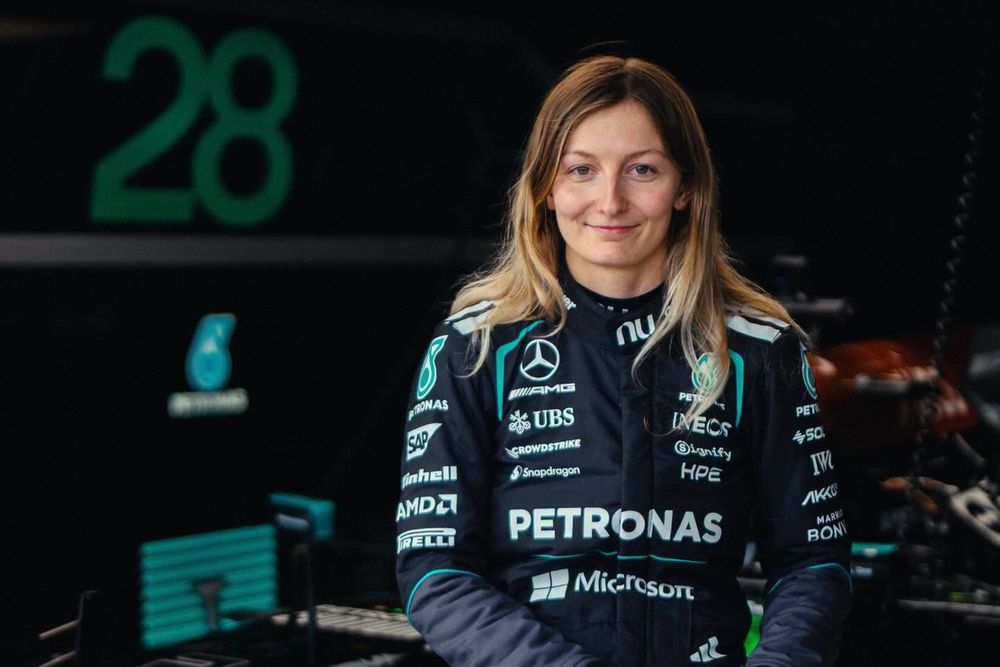
Mercedes is not a passive actor in this story. It has invested in Pin for years, made her a Development Driver, and then trusted her with a historic test that the team itself presented as a milestone. That matters because teams decide whether women are visible passengers in the conversation or actual participants in the pipeline. If a front-running team treats a female driver as a serious development project, the rest of the paddock has less room to hide behind vague claims about “future potential.”
There is also a competitive logic here. Pin’s test is not only good optics; it is proof that Mercedes is willing to use its own infrastructure to prepare talent rather than merely comment on it. That is exactly the kind of long-term intervention Formula 1 has often lacked when it comes to women. The sport does not need another slogan about diversity; it needs teams willing to put women in current programs, current cars, and current conversations about seats.
Susie and Toto Wolff
This is where Toto Wolff and Susie Wolff become potentially transformative figures. Toto Wolff leads one of the most powerful teams in Formula 1, while Susie Wolff now runs F1 Academy, the all-female series designed to create a clearer route upward for young women in the sport. That combination is unusually important because it links the development ladder to a front-running F1 team rather than leaving them in separate worlds. Few couples in motorsport possess both the operational power and the developmental mission to influence the pipeline in such a direct way.
Susie Wolff’s own career gives the structure moral credibility. She was not only a racing driver and Williams development/test driver; she was also the first woman in decades to take part in an F1 weekend session, and she now oversees the academy designed to move women closer to the top tier. That makes her more than an advocate; it makes her someone who understands the gap between potential and access from the inside. Her role can matter because it translates the abstract idea of “support women in motorsport” into a pathway with track time, visibility, and performance targets.
Toto Wolff matters for a different but complementary reason. A top team principal can turn belief into opportunity, and Mercedes has already shown that it is willing to place Pin into serious machinery rather than keep her in a purely promotional role. If Mercedes continues to back a female driver with real mileage, technical exposure, and a route toward top-level seat discussions, it could become one of the few teams able to change the conversation rather than simply participate in it. The key is continuity: one historic test is powerful, but a sustained program is revolutionary.
The next seat
Doriane Pin should now be discussed as a real prospect, not an inspirational exception. She has already demonstrated the two most important ingredients for a future Formula 1 path: performance in high-pressure junior categories and the trust of a major F1 team. The remaining obstacle is no longer whether a woman can drive an F1 car, but whether the sport will finally align opportunity with merit at the top level. If that happens, Pin is well placed to be one of the first names in the conversation.
That is why this moment should reignite the discussion around women acquiring Formula 1 seats. Not because representation is a decorative bonus, but because motorsport credibility demands that the fastest, best-prepared drivers get the best machinery — regardless of gender. Pin’s Silverstone test does not end the debate. It exposes how much longer the sport can afford to keep delaying the obvious.