
 Atanaria
Baltasar Kormákur’s Apex opens with a striking reminder that mountaineering is never just a physical challenge—it is a delicate negotiation between human instinct and the unforgiving logic of nature. From its first moments, the film establishes climbing as both an art and a science, requiring not only strength but also patience, calculation, and an almost poetic sensitivity to one’s environment. This thematic foundation becomes the backbone of a survival thriller that is as visually arresting as it is narratively straightforward.
The opening sequence is easily the film’s most memorable. Sasha (Charlize Theron) and Tommy (Eric Bana), partners in both love and adventure, awaken suspended on the sheer face of a mountain. Their tent clings impossibly to a vertical cliff, with nothing but empty air beneath them. It is a breathtaking introduction that immediately situates the audience within the film’s central tension: the precarious balance between human ambition and natural forces. Kormákur, already familiar with the genre through Everest, demonstrates a confident command of space and scale, immersing viewers in a world where every movement carries risk.
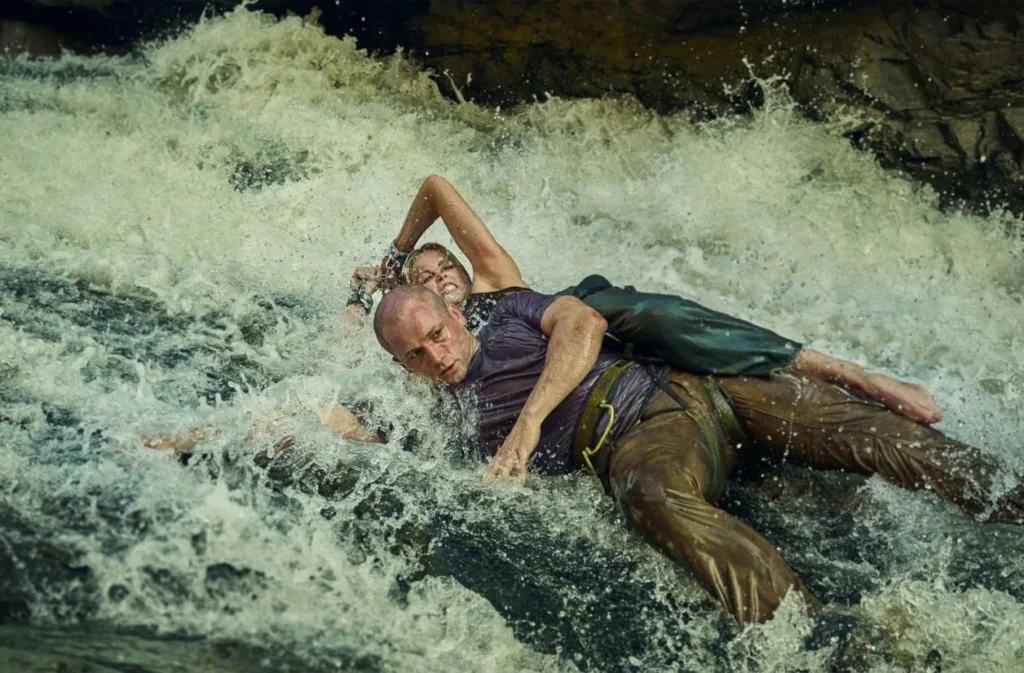


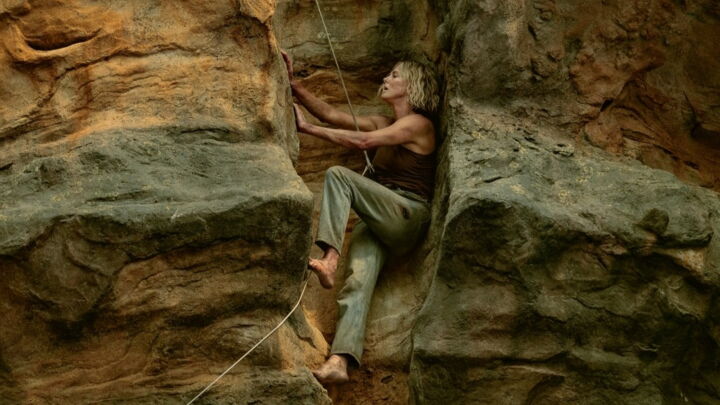
However, Apex quickly pivots from mountaineering spectacle to psychological survival narrative. After a tragedy that reshapes Sasha’s life, she retreats from climbing and seeks solace in solitude, embarking on a kayaking journey through the Australian wilderness. This shift from vertical ascent to horizontal drift mirrors her internal state—no longer striving upward, but instead searching for equilibrium and healing.
Yet the wilderness she enters is far from serene. Early encounters with unsettling locals and ominous warnings from a park ranger foreshadow the film’s central conflict. The suggestion that people have disappeared along this route introduces a layer of dread that contrasts sharply with the natural beauty surrounding Sasha. When she meets Ben (Taron Egerton), whose charm masks something more sinister, the film transitions fully into thriller territory.
Egerton’s performance as Ben is one of the film’s standout elements. He brings an unpredictable volatility to the role, oscillating between friendliness and menace with disquieting ease. His wide-eyed intensity and sudden bursts of aggression make him a compelling antagonist, one who feels disturbingly human. In contrast, Theron’s Sasha is defined by restraint and resilience. Her performance is grounded, emphasizing physical endurance and quiet determination rather than overt emotional display. This dynamic creates a compelling cat-and-mouse structure, where psychological tension is as important as physical survival.
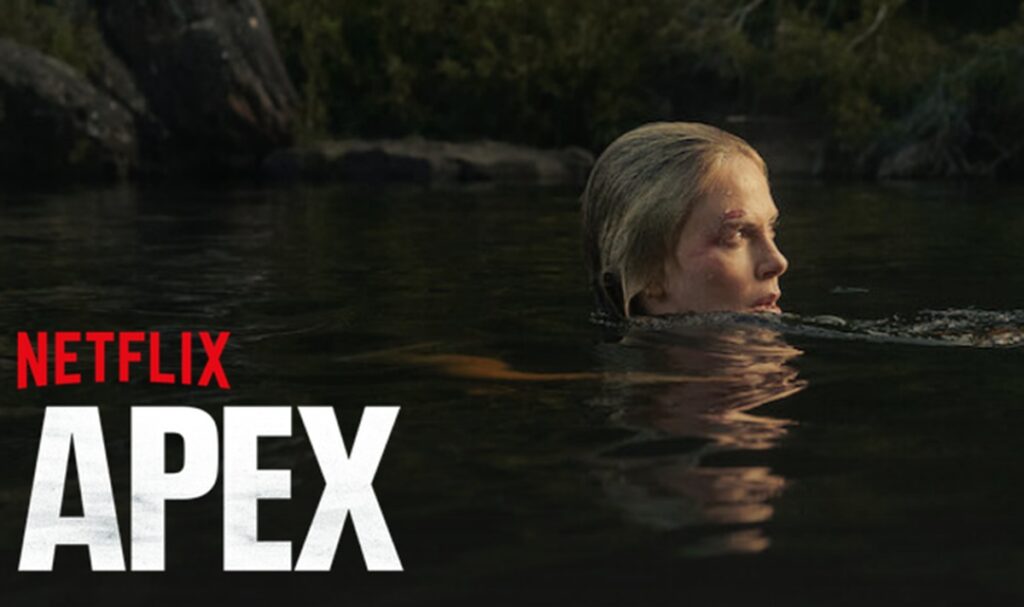
What makes Apex particularly engaging is its subversion of expectations regarding danger in the wilderness. While the setting suggests threats from nature—treacherous rapids, steep cliffs, and lurking wildlife—the true menace emerges from human cruelty. The film subtly critiques the romanticization of nature as humanity’s greatest adversary, instead positioning human violence as the more insidious force. The wilderness, though dangerous, is at least governed by consistent rules; Ben, by contrast, is unpredictable and malicious.
Visually, the film excels. Kormákur makes full use of the Australian landscape, integrating its rivers, caves, and waterfalls seamlessly into the narrative. Each location is not merely a backdrop but an active participant in the story, shaping the characters’ choices and the progression of the plot. The action sequences are particularly effective, combining practical stunts with careful choreography to create moments of genuine tension. Whether Sasha is navigating violent rapids or evading capture in dense जंगल terrain, the film maintains a visceral sense of immediacy.



However, Apex is not without its limitations. The film deliberately keeps character backstories minimal, focusing instead on action and momentum. While this choice enhances pacing, it also results in a certain emotional flatness. Sasha’s grief, which initially appears to be a driving force, is only lightly explored, and Ben’s motivations remain largely अस्पष्ट. As a result, the narrative occasionally feels repetitive, relying on a series of pursuit-and-escape sequences that, while thrilling, lack deeper psychological development.
That said, this emphasis on surface-level storytelling can also be seen as a strength. In an era where many films over-explain character motivations and emotional arcs, Apex opts for a more immediate, experiential approach. It prioritizes sensation over introspection, inviting viewers to engage with the film on a visceral level. The result is a tightly constructed thriller that delivers consistent tension without becoming overly burdened by exposition.

Ultimately, Apex succeeds as a piece of entertainment that knows exactly what it wants to be. It does not attempt to reinvent the survival genre but instead refines its core elements—stunning visuals, physical stakes, and a relentless sense of खतरा. Charlize Theron anchors the film with a performance that is both physically demanding and quietly compelling, while Taron Egerton provides a formidable counterpoint.
If the film occasionally sacrifices depth for momentum, it does so in service of a gripping cinematic experience. Apex reminds us that survival stories do not always need to probe the deepest corners of the human psyche to be effective. Sometimes, it is enough to place a character in an extreme situation and let their instincts—and the audience’s—do the rest.